

Fujiyama Cottonton by Taku Aoyagi

Fujiyama Cottonton by Taku Aoyagi
In-venue Programme
In-venue Screening
 Date
Date
8 March 2026 (Sun), 3:35pm
 Venue
Venue
Language: Japanese
Duration: 95 minutes
Online Screening
Date
Language: Japanese
Duration: 95 minutes
In the Kofu Basin below Mount Fuji, balmy soft wind wafts through cotton fields bathed in sunshine. It is home to Mirai (Future) Farm, a welfare facility for people with disabilities. Yet they do not just receive care—they work hard to provide for themselves by planting cotton, weaving fabrics and tending to flowers. In the documentary film Fujiyama Cottonton, director Taku Aoyagi’s unadorned lens captures scenes of everyday life in a community with diverse abilities, conveying the most sincere and heartfelt emotions in their ordinary existence.
Every morning, everyone at Mirai goes to work with joy. They first do some light exercises to perk themselves up for a full day of labour. They take their tasks seriously. From tilling soil, sowing seeds, watering to fertilising, every step is performed with great care, and every cotton boll is the fruit of hard work. Some turn cotton into yarn, approaching the repetitive grind with dedication and joy. Meanwhile, seasoned weavers operate looms with great precision, working diligently to fulfil the long queue of customer orders. Mirai Farm not only shows the day-to-day operation of a welfare institution but also a microcosm of society, where people divide work and cooperate with each other to give meaning to their lives. The only difference is that efficiency is not the goal here. Rather, profound respect is paid to every individual’s distinct talents, traditional craftsmanship and unique pace of life.
What also makes the film touching is the emotions so readily and generously reveal. Whether romance or friendship, excitement or heartbreak, these are human experiences we all share. Oomori is a listless, sad man always sitting forlornly by the cotton field. As it turns out, he has been grieving over the loss of a close friend. Fortunately, as the cotton continues to grow, he soon regains a sense of purpose and starts enjoying life again. Tatsunari works as a farmer but is actually a photographer at heart, unbeknownst to everyone else. By pure instinct, he captures the facility members and their talents on the farm, allowing the audience to transform from watching “the other” to viewing “with the other”. Also inside the establishment is a painter whose work echoes Yayoi Kusama’s worldview of “infinity”—boundless, no limits.
Fujiyama Cottonton unfolds in near silence. Aoyagi’s gentle and unadorned lens crafts the narrative of every person patiently and meticulously. Through all the intimate details, the audience perceives the reality of life for those who have long been neglected by society. People in the film speak little, and yet from their non-verbal cues, the audience can feel their sincere and emotional exchanges. This is what their lives are—so authentic and ordinary. Consequently, Fujiyama Cottonton is hailed by Japanese critics as “one of the gentlest social documentaries”, weaving a tapestry of humanity with light and shadow.
Witnessing Everyone’s Joy (at Mirai Farm)
The purpose of making the documentary Fujiyama Cottonton, as its director Taku Aoyagi said, is simply to convey this idea: “A different world truly exists here.” Mirai (Future) Farm was the workplace of the director’s mother, as well as his playground growing up. “After school, I would come to draw paintings and make bead crafts with the facility users. Back then, I did not have the faintest idea about ‘people with disabilities’—they were just ‘elder brothers and sisters’ who played with me.”
When it comes to a welfare facility, many view it as a “place of protection”. In reality, it is more like a “mini society” where everyone works and banters at their own pace, occasionally having worries. Shot with tenderness and subtlety, Aoyagi’s documentary features his subjects with minimal dialogue and no narration at all, letting the visuals tell the story. He observes quietly, capturing the residents’ snippets of life with a light touch that resonates with the audience nonetheless: “I make it a point not to ‘over-explain’. My belief is that by looking closely at the minute details of people’s lives, their character will naturally emerge. Also, non-verbal communication can be incredibly rich. A hearty laugh with a gentle rub on the belly, or just an exchange of glances—all these convey inner thoughts.”
Beyond work, Aoyagi also documented their personal interests. “Creative activities like photo-taking, drawing and weaving are not separated from work. Growing and harvesting cotton, which later becomes weaving material, is part of the residents’ labour which, at the same time, highlights the sentimental side to their character. For instance, the work by Tatsunari, a camera buff, comes across as ‘the way he has chosen to relate to the world’. Toward the film’s end, Tatsunari suddenly asked me while I was wielding my camera: ‘What is work?’ In that moment, I replied out of reflex: ‘Making money’. He offered a response rooted in an entirely different perspective: ‘It is about showing others that everyone at Mirai Farm is happy.’” This provoked in Aoyagi a deep reflection—not only on filmmaking but also on his own way of life.
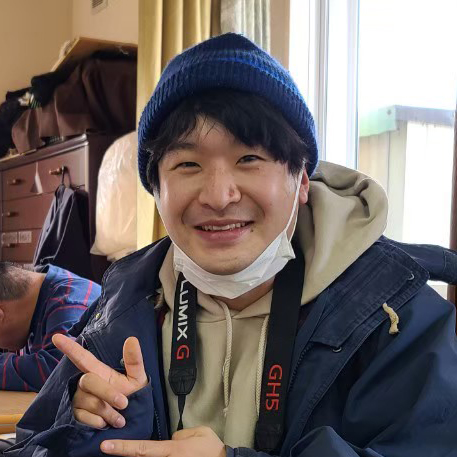
Director Taku Aoyagi
Documentary director and cinematographer Taku Aoyagi was born in 1993 in Yamanashi, Japan and studied at the Japan Institute of the Moving Image. He is known for the films The Road He Walks: A Story of He-kun (2017) and Tokyo Uber Blues (2021).


